Hip-Hop Lives Here

Hip-Hop Lives Here

Lucy Railton’s new album Blue Veil isolates the moment when a cello’s bow makes contact with the strings and presents it as a miniature Big Bang, a crucible of tension and friction that burns fiercely on a level that’s too small to see. In a fascinating interview with German writer Stephan Kunze, the UK composer and cellist described the experience of playing her instrument as like “standing next to a guitar amp,” and Blue Veil does everything it can to make you feel the vibrations short of grabbing your face and pressing it up against the strings.
Though Railton found a nice old Paris church in which to record these seven pieces, we don’t hear any of the space in the music. Rather, she distills some sort of platonic ideal of cello-ness. You get an acute sense of the instrument as a machine, yet it’s seemingly stripped of its constituent parts: no wood, no wire, no horsehair, just a deadly and wicked thrum. You feel like you’re inside the instrument, or maybe like you’ve shrunk down to ant size and are running along one of the strings as the bow bears down on you. The music sounds like a slumbering beast at times, breathing with each stroke, betraying its human source even when the eerie just-intonation overtones start to sound like theremins or outer-space rumblings.
This is Railton’s first solo cello album, but she’s been a regular presence in the classical avant-garde for a while, organizing a long-running concert series at London’s Café Oto and co-founding the London Contemporary Music Festival in between gigs with the likes of Bat for Lashes and Bonobo, and Bach recordings on ECM. She might be best-known for her work with Kali Malone, who co-produced Blue Veil with Stephen O’Malley. The same trio recorded the awesome pandemic-era drone album Does Spring Hide Its Joy, which seems pulled from the same inky depths as the music on Blue Veil; both records use barely audible sine waves to heighten the low end, contributing to the feeling of the music seeping into your bones that Railton must feel as she plays her mighty instrument.
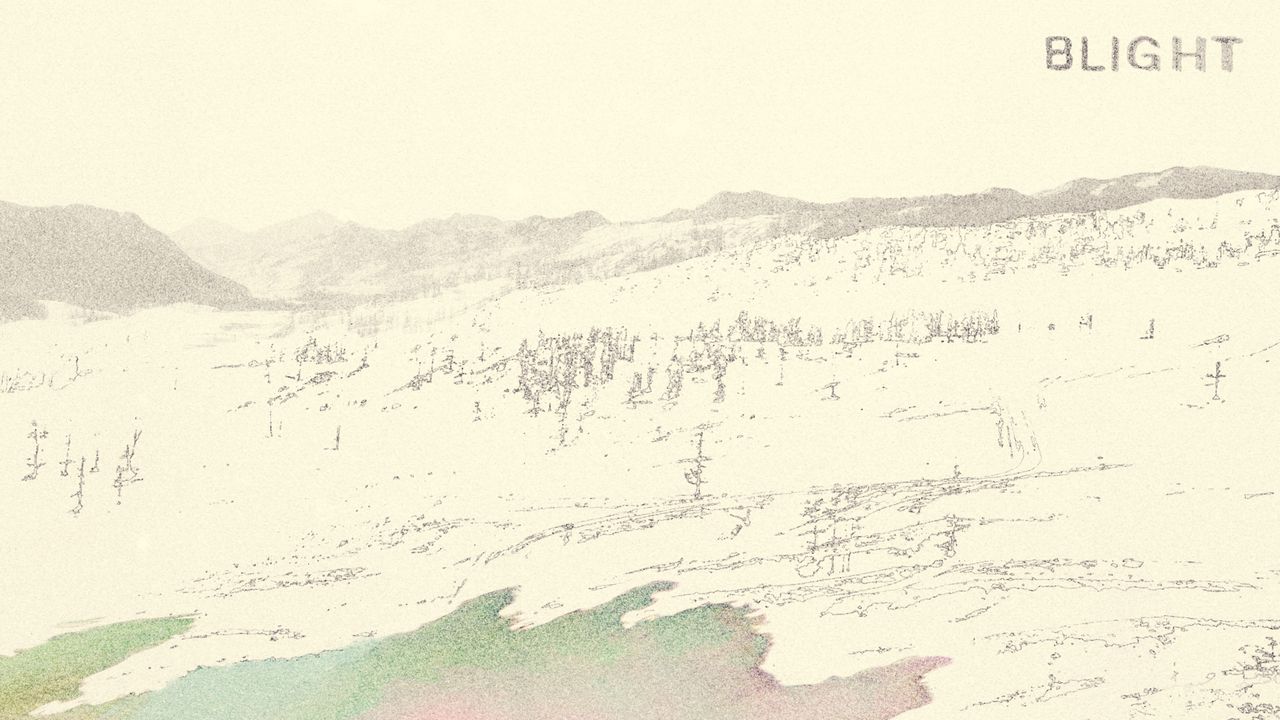
In a sense, Blue Veil puts you in the driver’s seat, breaking the polite distance between player and listener that usually manifests in the sense of space Railton rejects here. She uses subtle electronic sine waves not as an embellishment but to bring out qualities within the cello itself, namely the physicality of her experience of playing it. There are times when the timbre of the cello sounds hyperreal, almost like a computer preset; Railton displays little dynamic range as she patiently, almost surgically traces the edges of cool minor chords and discordant clusters. If you were to illustrate Blue Veil, it would look like seven streaks of black ink, or maybe seven slashes in a canvas from a very large knife.
It’s austere, formidable music, but by fitting within a tight 40-minute package, it endears itself to listeners who might not know much about drone music—for instance, ambient fans familiar with Railton’s work with Malone, or in the trio PDP III, with Britton Powell and Huerco S., but not quite ready to make the leap to blasting Phill Niblock at deafening volume. If that’s you, here’s your gateway drug. For the rest of us who already love such spartan music, here’s another album to plug straight into your bones.
 Share
Share
Advertisement


De La Soul’s tenth studio album is built around a steady and unwavering mission: to honour the life and legacy of founding member David Jolicoeur (also known as Trugoy The Dove) after his heartbreaking death in 2023. Speaking with NME earlier this year, MC Posdnuos remembered what Jolicoeur’s family told them at the funeral: “If y’all stop, Dave stops. We’re not putting necessary pressure on you, but we would love to see y’all continue on.”
The fact that De La have not shared a release since their Grammy winning 2016 album ‘And The Anonymous Nobody’ makes it clear that they only speak when they have something meaningful to offer. With so many layered emotions around grief, reflection, and legacy rising to the surface, this moment feels right for such a powerful return.
Drawing together an impressive gathering of talent, including iconic hip-hop figures like Nas, Slick Rick, Q-Tip, Pete Rock, Black Thought, and DJ Premier, all acknowledged in an extended opening roll call, Posdnuos and Maseo aim to craft an experience that fully pulls you in. With poetry and spoken word woven throughout, sweeping orchestral touches, and a clean, grounding narration from actor Giancario Esposito, ‘Cabins In The Sky’ attempts to capture the long process of facing Jolicoeur’s absence while firmly insisting on his lasting presence, expressed through lines like “When its Pos and Maseo you see, the magic will always remain three” (‘YUHDONTSTOP’).
One of the album’s most emotional moments arrives on ‘Different World’, which features poet Gina Loring and showcases some of Pos’ most exposed and heartfelt writing to date. Blending internal rhymes with a gentle flow that pulls you along, he shares: “Hard for me to cry, ‘cause I’m thankful… steering us through right and left turns / What we earn is another angel on our side.”
It is important to recognise that this album is not weighed down solely by sorrow or sentimentality. Instead, it stays grounded in the reality of the world we are living in now, offering plenty of new and outward-looking thoughts. On ‘YUHDONTSTOP’, Posdnuos reflects, “There’s high stakes being played around the world, and it’s understandable to be rooted in the present,” while also speaking honestly about De La’s place in contemporary American culture: “Some young ones don’t think we got that edge… Telling us ‘you a pioneer’ means you have American Pie nowhere near you.” Elsewhere, ‘A Quick 16 For Mama’ brings a tribute to the love and sacrifice of mothers alongside Killer Mike, and ‘Just How It Is’, which explores the story of a woman betrayed by her partner, highlights the deeper empathy and insight that maturity has given Posdnuos.
While De La Soul’s reflections on society are sharp and clear, the heart of this project belongs to David Jolicoeur and the space he has left behind. By examining the deep influence he had on their lives, both personally and creatively, the remaining members of the group shine a light on his essential contribution to American hip-hop and show exactly why they continue to be celebrated as some of the culture’s most cherished voices.
Share
Advertisement