Share
Share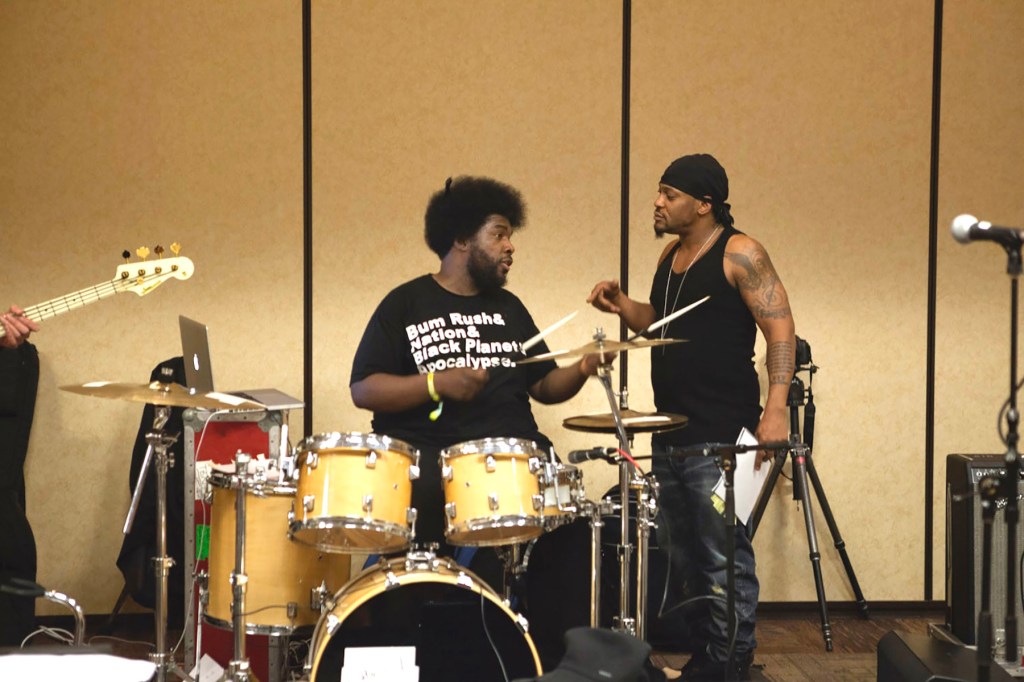
When I woke up on the morning of Tuesday, Oct. 14, I stared at my phone for a long moment. Calls that early never bring good news. I took a deep breath and tried to brace myself. I already knew, but I didn’t know.
Sigh. But deep down, I knew.
I had one foot firmly planted beside D’Angelo in the fight, and the other halfway accepting that maybe it was time to let him go. D himself said in our last conversation at Sloan Kettering, “I’m hanging on, brotha… but today was hard… you know?”
I know, man. I know.
Still, I wasn’t ready for that kind of blow. I had been expecting it for nearly 25 years, ever since the flood of Voodoo in 2000. There was always a quiet fear in the back of my mind — that any day, I’d get the call. So many of our greats who flew that close to the sun never made it all the way through. And now, here it was, 5:30 in the morning.
I had only a few seconds to decide how to process this new reality. I didn’t want to start my Tuesday morning in mourning.
Tears began to fill my eyes as I searched my mind for something good — a bright memory to slow the feeling that my stomach was a piano tumbling down a San Francisco hill. Just one moment that could make me smile. And then it came to me.
It was May 1997.
We were on a dinner break, eight months into what we didn’t yet know would become a four-year stretch at the Electric Lady Soul Prison, working on Voodoo. Michael Jackson had just released Blood on the Dance Floor. Not exactly a major event for us at the time, but MJ always deserved a listen.
Then we heard “Morphine.” Or more specifically, we were caught off guard by the bridge. One moment it was Nine Inch Nails chaos, and the next — that coda. Cue up the song at 2:37 and imagine hearing that in the studio for the first time.
You know those memes of brothers at an outdoor table laughing so hard they cling to each other before falling over? That was us. We laughed until it hurt. I had to send a studio assistant for Advil. Don’t get me wrong — I’m MJ for life — but that bridge wasn’t what I expected from the master of James Brown’s school of the groove.
We played it six more times, driving everyone in the studio crazy. We mocked it with love, and it somehow became one of my favorite MJ moments on record.
Speaking of laughing until it hurts, our Soulquarian brother James Poyser once reminded me that aside from Busta Rhymes, no one could break bones with a double-snap greeting like D. Sometimes I’d skip shaking his hand just to protect my drumming wrist. Pain is love, but even love has limits.
D’Angelo, to me, was one of the last truly pure artists in Black music. I know we sold the mystique and the seriousness well, but the truth is — we were a goofy bunch.
I’ll admit I might’ve had a few more years of friendship if not for what happened early on. Three days after Christmas in ’93, the Roots were mixing our major-label debut. Engineer Bob Power kept raving about some “Mike” who was apparently the second coming of Marvin Gaye, Al Green, and Frankie Beverly. I wasn’t buying it. To me, no one was touching Prince’s reign from a decade earlier.
Then “Mike” walked in. Game over. His Timberland chukkas were leaning like a scene out of “Smooth Criminal.” There was no way this guy in those dusty Timbs was the future. I gave him a pound and retreated to the break room to use the free long-distance phone. (Ironically, I dismissed J Dilla the same way a year later. Guess I’m lucky.)
Cut to two years later — the 1995 Source Awards. It felt like a turning point for hip-hop. I’ve said before that it was hip-hop’s funeral. Maybe that’s an exaggeration, but nobody walked away unchanged. East Coast versus West Coast stopped being a myth. Materialism against consciousness. Dre won Producer of the Year, and New York booed. Then Snoop shot back, “Y’all don’t love us?!?!” I could feel the tension rising, so I bolted like Tom Cruise in War of the Worlds.
Outside Madison Square Garden, I ran into some street promoters. One kid looked me over and said, “You’re gonna love this.” He handed me a sampler cassette. To be polite, I pocketed it. Normally I never listened to those. But later that night, still shaken by the chaos, I noticed the name “Bob Power” on the case. Wait — what’s a D’Angelo? Brown Sugar? I popped it into my Walkman. By the twelfth second, I was hooked. The music was confident, precise — thirty years of soul history and the next thirty in one breath.
Then the realization hit me in slow motion, like Ralphie’s line in A Christmas Story: “Ohhhhhh fudge — this is Mike! The Timberland guy!”
Rewind to April 1, 1984. Marvin Gaye was shot by his father. For both D and me, that date carried a strange mix of reverence and darkness. We both had complicated fathers, full of love and its opposite. That tragedy became a lens for our own struggles. My father used Marvin’s death as a quiet warning — respect is real, and disrespect has consequences. I grew up under that shadow. So did D.
Jump ahead to April 1, 1996. Our first real conversation, framed by Marvin from start to finish. The Roots were touring with the Fugees and Goodie Mob, and I met D at the House of Blues in L.A. during Soul Train Awards weekend. One of the first things he told me was that he had just recorded “Your Precious Love” with a singer he’d recently met named Erykah Badu — who we also met that weekend. Three generals of the same army meeting for the first time. No big deal. Later, D admitted that the intro of “I Heard It Through the Grapevine” haunted him. It genuinely scared him. For me, that kind of fear came from the modulated coda of Curtis Mayfield’s “Freddie’s Dead,” which I first heard while injured as a kid.
Of course, I had to test him. Not long after, I played “Grapevine” in the studio and turned it all the way up.
D wasn’t lying. He froze. I might have kept the prank going, but by the second try, I knew a third would end with fists.
We never brought up “Grapevine” again. Ever.
A year later — April 1, 1997. After a tough split with management, D’s career was in flux. His former manager had a demo called “Bitch.” It wasn’t ready, but it hinted at what Voodoo would become — raw and beautiful. Another artist that manager signed (let’s call them “Redacted”) got hold of the tape and later released something suspiciously similar.
That really got under D’s skin. To me? Just another chance to mess with him.
The Roots were mixing Illadelph Halflife at Battery Studios, while the Soulquarians — Common, Erykah, D, and others — were working across town at Electric Lady. I called Rahzel, our human beatbox, and asked him to prank D, pretending to be “Redacted” accusing him of stealing. “You bit my style!” I whispered as I stayed close enough to hear.
Most people would have thrown hands on the spot. D got angry, but in the most D’Angelo way possible.
“Man, you’re fake! Your chords are trash. You don’t know how to layer vocals! Your vibrato’s weak! Your lyrics suck! Bring it! I’ll battle you on any stage, any time!”
Wait, what? He went technical. That’s when I realized I was dealing with a true artist — someone who couldn’t stop thinking about music. Who else critiques chord progressions mid-beef? Turns out I was the one getting schooled.
That was D at his most intense.
During the Voodoo sessions, he once called at 4 a.m. saying, “Yo man, we gotta talk.” I thought it was serious. Turns out he couldn’t sleep because he thought Common had a funkier track for Like Water for Chocolate — which we were both working on — than he did for Voodoo.
“That’s my funk! He doesn’t know what to do with that funk!”
I called Common and suggested a trade. He didn’t mind. “Chicken Grease” went to Voodoo; “Geto Heaven Pt. 2” (originally featuring D and Lauryn Hill) went to Common.
Then came Voodoo. Then came everything. That record reshaped Black music. There’s a before and after. The tour that followed was the greatest soul revue since Prince in his prime — we spent four years studying him, and this was our love letter in return.
But D’s core never changed. One day on tour, in some random city like Milwaukee, Halle Berry happened to be side-stage during soundcheck. I couldn’t see her behind my cymbal, but D could. Suddenly, the soundcheck turned into a full-on performance. He went all out — mic tricks, spins, slides, everything. At one point, a nail ripped his pants from thigh to ankle. They became a skirt. And yeah, he was commando.
That was D — all in, even at rehearsal.
He was the same way in the studio. Fourteen years between Voodoo and Black Messiah — a lifetime. When I came in for the latter, every piece of Voodoo equipment was still there, untouched. “Guys,” I said, “why are we using VHS tapes and floppy disks from 1997? The world has moved on.”
Not for him.
“We’re going full vintage,” he said.
I didn’t understand it then, but that was his heart — pure dedication disguised as stubbornness.
He was supposed to headline the Roots Picnic this summer. We rehearsed two weeks out. He was always private, but something felt different.
The first sign was rehearsal starting late — even by his standards. I scheduled for 10 p.m. but we didn’t start until 3 a.m. By seven, I had to leave for a flight. He looked disappointed. “Where you going? We only played a few hours.”
Looking back, I realize his timing was off for a reason. He struggled to hold his guitar, choosing to stay at the keyboard instead. I thought it was an artistic decision, a throwback vibe. I didn’t see the medical truth unfolding. When I asked, he said he’d been through something but was recovering.
Even so, that final rehearsal felt like closure. I remember thinking, “Why does it feel like this is the last time I’ll play this song with him?” I tried to shake it off, but the feeling lingered. And then the unthinkable happened.
Maybe it’s hindsight, but that night stood out because he didn’t fight me on the one thing he always resisted — playing songs as they were on the album. For him, that felt lazy. In twenty-five years, we had only done the “normal” versions once. For the Picnic, I suggested we just play Brown Sugar straight through, simple and free. He agreed right away. Too easily.
The last few weeks with him ended up being some of our best. Music had always been how we communicated, but now we sat in the hospital — no instruments, no noise, just the two of us. We talked about our lives, what had changed over the last few years. There was an awkward sense of finality. I wondered, “Is this the last time I’ll visit? The last concert we’ll share? The last Dilla beat we’ll lose our minds to?” Since that first talk in 1996 about our hometowns, our fathers, our churches, we had never gone this deep.
For thirty years, our conversation had been through sound. The world listened in, but it was really just us talking in rhythm and melody.
I was scared to tell him where my life had gone since we first met. I worried he’d think I’d become too “professional” — too busy, too far from the core. Would he feel like I’d turned him into another tragic story in my long list of fallen heroes?
Then we both stopped overthinking. We spoke honestly.
What came out was healing I never expected. We had both been exploring spirituality, metaphysics, energy. We talked about astral travel. I played koshi bells and binaural tones on loop in his hospital room. Crystals, candles, incense, oils — it felt peaceful. We shared Dr. Joe Dispenza videos and Spirit Science clips. We’d both reached a space of calm and growth.
Then, almost on cue, the hospital machines started beeping, echoing the sounds from MJ’s “Morphine.” We looked at each other and just smiled — the same brothers who once laughed at that song until we cried.
We were still us. Still brothers. Still here.
(Whew… I knew it, man. I knew it.)