



logo

Hip-Hop Lives Here

Marcus Brown talks about his ongoing hesitation toward the music industry

image

He is signed to a major label, has two celebrated projects to his name, and has performed around the world, yet Marcus Brown still feels like he exists on the outside looking in. That feeling may come from the fact that the twenty nine year old spent nearly ten years working quietly, releasing a series of projects under different names before anyone finally noticed him. “I didn’t think I’d be recognized until I was dead,” he said to me over Zoom. “I never thought that would ever happen to me.” As Nourished by Time, the Baltimore born artist creates music that floats between recollection and what feels like a glimpse into the future. His writing offers tired observations about a world that seems to be falling apart, softened by the glow of nineties R and B and the restless drive of post punk. But even when his music confronts heavy truths, it never feels hopeless. His instinct to slide optimism into humor is what keeps him going. “As I get older, I become more just left, left, left,” he joked. “As long as I can preach that and be who I am, I don’t really care.” Right before he headed out for the international stretch of his tour, we spoke with Brown about his slow rise into public view, how he manages the realities of touring, and his recent stop at the Mall of America.

EMILY SANDSTROM: The first thing we have to get out of the way is, I’ve literally been listening to your music since I was 18. You’re one of the first people I met in Boston.

MARCUS BROWN: I know, it’s really funny.

SANDSTROM: We’ve been SoundCloud friends for that long, and now you’re like a whole career musician.

BROWN: I know. I’m a real artist now. 

SANDSTROM: You’re really doing it. I feel validated in my taste.

BROWN: I feel like that doesn’t happen often, so that’s pretty cool. And that was such an important scene in Boston at the time. It was like a weird art-kid/punk/emo mix. It was kind of an underground community, with everyone going to house shows and hanging out in Allston.

SANDSTROM: Yeah, that time was funny. And there was kind of a softness to everyone.

BROWN: Yes, definitely. I followed a lot of that type of music online, so being able to be a part of it was really fun. I would write music and go to Allston and just get into some bullshit. I forgot that I’ve really been putting out music for that long, just under different names.

Nourished by Time

SANDSTROM: I remember some. I remember when you were Riley with Fire.

BROWN: Yes, that was the first one.

SANDSTROM: But there’s a few that I’m missing.

BROWN: There was Mother Marcus.

SANDSTROM: Oh, yeah. You had that for a while. 

BROWN: And then the next one was Nourished by Time. That was it.

SANDSTROM: I remember all the music you would put out. But there was this one time you did a cover of a Carpenters song and it really stuck with me. It was “Superstar,” I think.

BROWN: “Superstar,” yeah.

SANDSTROM: I loved that so much. It was very vampy. 

BROWN: I feel like I have that somewhere.

SANDSTROM: You should send it to me if you find it. But anyway, it’s like I blinked and you were Pitchfork’s Best New Music overnight. I was like, “What the fuck?”

Nourished by Time

BROWN: I know. 

SANDSTROM: I don’t actually know the whole story. How did that happen?

BROWN: I was living in L.A., and kind of had a mental breakdown and just drove back to Baltimore. Then I was just putting music out on Instagram and then this random dude in England saw my stuff and was really into it and sent it to his partner, and then his partner sent it to her best friend, and then her best friend wound up sending it to the label that I wound up putting on music under, called Scenic Route in London. It was kind of kismet and natural.

SANDSTROM: Yeah.

BROWN: From there it kind of just happened, the music and the performances snowballed into this whole community now that we have, which is really cool.

SANDSTROM: When did you sign to XL? 

BROWN: I think it was February last year.

SANDSTROM: Was that like a crazy, “I made it,” moment?

BROWN: Yeah, I never thought that would ever happen to me. I still don’t even think I realized how awesome it is. I never thought I would see this level of attention for my music. I thought it would happen when I was just 40 or 50, or I’d be dead or something.

SANDSTROM: I feel like you’re a really great example of why you just have to keep putting stuff out there over and over. Like if you’re making shit, just keep posting.

BROWN: Thank you. I agree. I think there’s also a level of delusion you have to have at a certain point. I guess one of the good things about the streaming world is artists having more control. Like, if you want to promote and contribute to the creative process or the collective it really helps. I think that’s kind of what it did for me, ’cause no one gave a shit about what I was doing for so long. You of all people know that no one cared for a really long time.

SANDSTROM: Don’t worry, I gave a shit.

BROWN: Yeah, you were one of my hundred fans. 

Nourished by Time

SANDSTROM: I feel like you have an interesting perspective because things didn’t happen for you for such a long time. You’ve done the traditional DIY route, and now you’re kind of at the biggest label. So after all that, what do you think about the music industry now? 

BROWN: [Laughs] I still think it’s really bad. I don’t think of it any differently. With The Passionate Ones, I was trying to create inspiration for artists that were in my situation just two or three years ago. But also, nothing’s changed. Things have probably gotten worse. I can’t imagine what it’s like to be where I was at that time. But one thing I’ve been doing is trying to build community. When we were on tour, there were four shows where Zsela couldn’t play, so we had our friends from Berkelee join us and it was really fun. But one bit of advice I would give those artists though is, I wish I played more live music at the time. It really does help. I think I could have sped up a lot in those 10 years if I had just moved to New York and just played a bunch of shows.

SANDSTROM: Yeah, absolutely. I guess I don’t know this, but do you want to be like, famous, famous? Like, how famous do you want to be?

BROWN: I haven’t really thought about that until this tour where people were treating me like I was actually famous and it was really strange. But I don’t really think of it in terms of fame. I feel like fame is something that you can create without a product, and I’m not really good at that. But to answer your question, as I get older, I become more just left, left, left leftist. 

SANDSTROM: Yeah, and it comes up in your lyrics a lot.

BROWN: Exactly. So as long as I can preach that and be who I am, I don’t really care. And as long as it doesn’t get in the way of just music. I’m not really in it for fame necessarily.

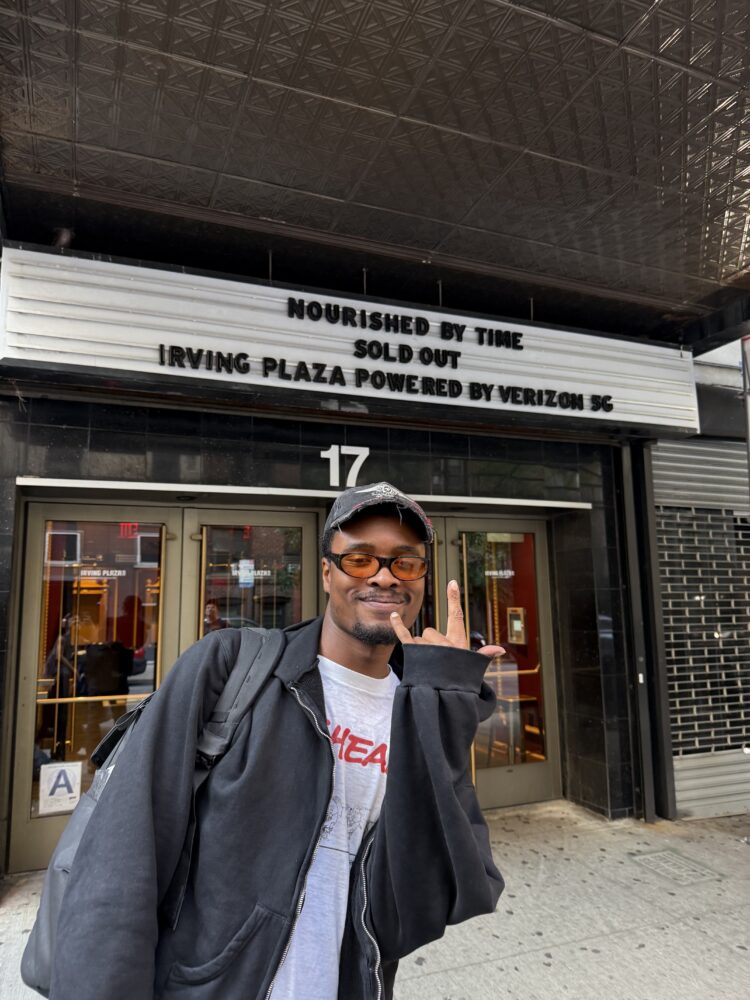
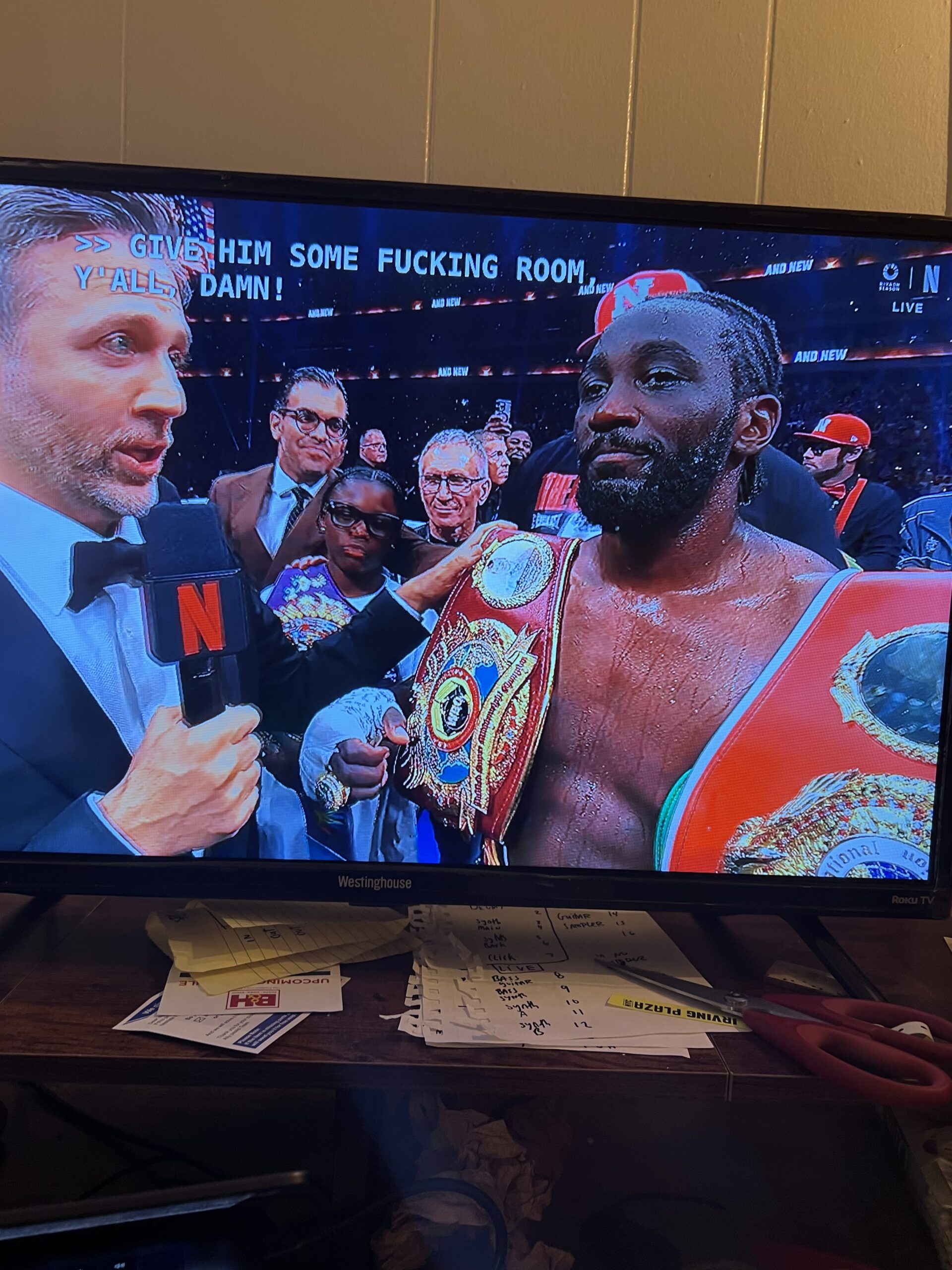
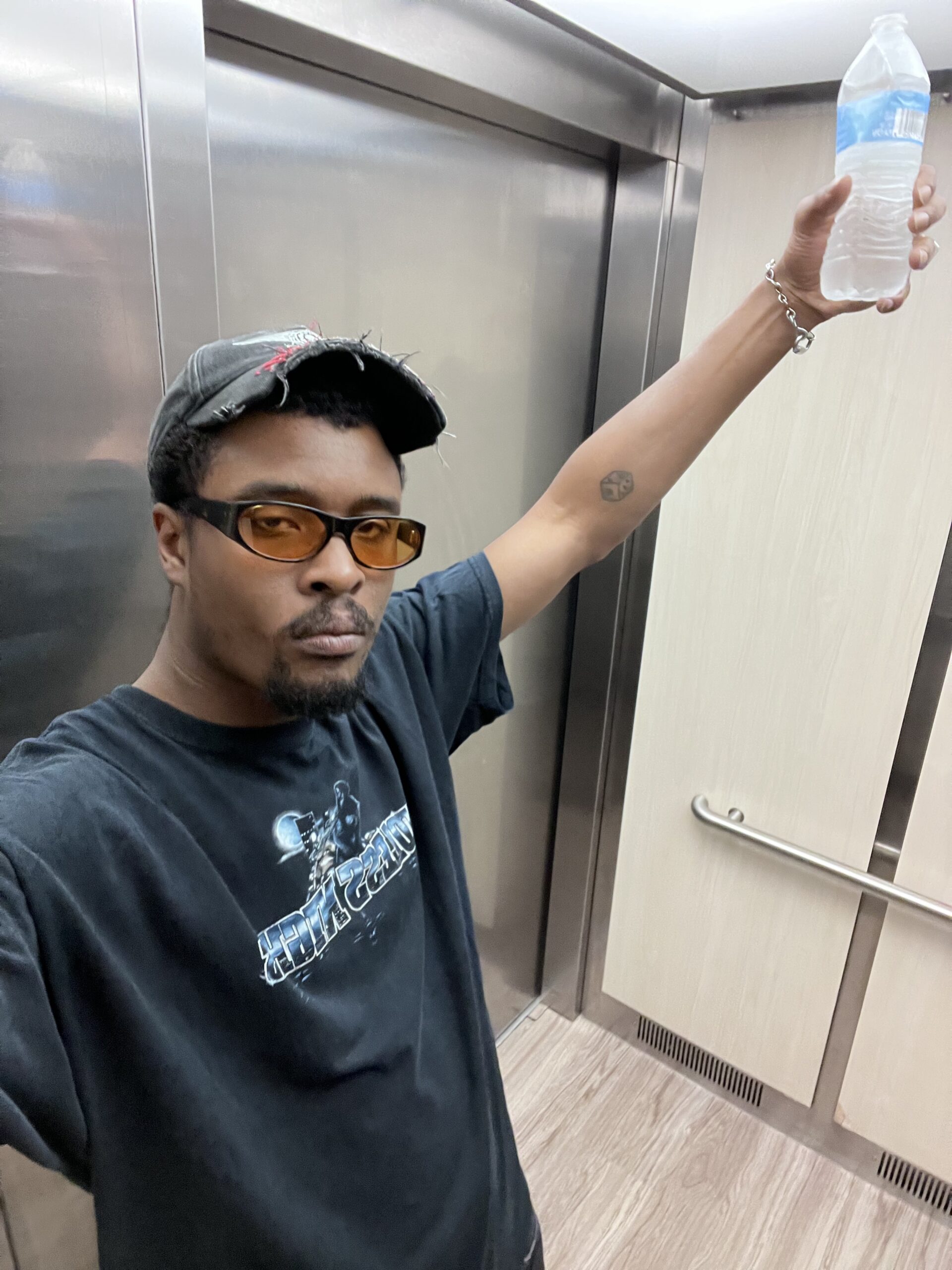
SANDSTROM: What’s this?

BROWN: That is Terrence Crawford. That was after we sold out Irving Plaza. We came back to my place and I really wanted to watch that fight. He’s fighting Canelo Alvarez. It was a big deal ’cause they’re both amazing fighters. It was a really good fight and it was one of the rare fights where they both came out of it with respect. It was a really wholesome fight, honestly. 

Nourished by Time

SANDSTROM: What is touring like for you? You’ve had a nomadic experience these past few years. This whole project has moved you around so much. You’re always tweeting, “I got Pitchfork Best New Music, but I’m still living in my parents’ basement.”

BROWN: Well, this tour in particular has been really fun because it was our first year having a tour manager. That took so much stress away from just the entire band. I was making beats the entire time. You know what’s strange, when I did that residency in West London two years ago, that’s when I realized my brain is a little different and this is the lifestyle I was meant for. I was basically living in a nightclub and it was a crazy building, but I just remember there was this Stella McCartney private party going on, and my bedroom was right across the hall. I slept like a baby the entire time. That was actually one of probably the best months of my life. 

SANDSTROM: [Laughs] That is absolutely insane. Do you get worn down?

BROWN: It does get tiring, but honestly it’s a really small price to pay for this type of labor that I find myself in now. Before I was doing really, really boring things that made me feel like I was wasting my life. 

SANDSTROM: For sure. Wait. What the fuck is this?! 

BROWN: That is in the Mall of America, which I always have to go to at least once when I’m in Minneapolis. And that’s a roller coaster that we went on.

Nourished by Time

SANDSTROM: That’s crazy. What are your favorite cities to tour in?

BROWN: Atlanta was insane, I’m not going to lie. L.A. was crazy. And we always start in Baltimore, so that’s always a really fun show.

SANDSTROM: Nice.

BROWN: New York was really crazy too. Honestly, they were all crazy except Houston. Even Milwaukee didn’t sell that well, but it was still a really cool venue and a really cool vibe. 

SANDSTROM: Have you ever had something really bad where you had to stop the show?

BROWN: No. But in Vancouver, there was this girl who kept heckling us. She was just screaming a lot of really sexually sensitive things. She was so loud and we couldn’t hear our own voices on stage. 

SANDSTROM: Oh, no. Not this. 

BROWN: It got weirder. I was like, “Hey, can you please just quiet down a little bit? We can’t hear anything.” Then for the rest of the show, she was crying and her friends were consoling her. Then after the show, her friends came up to me and I thought they were going to be like, “Hey, sorry about our friend,” or whatever. But they wanted me to apologize to her.

SANDSTROM: Oh no. Did you?

BROWN: I said, “Absolutely not.” I was like, “You guys are insane. Y’all don’t know how this world works.” I think, to this day, they still don’t know how weird they were.

SANDSTROM: That’s really funny and also really scary.

BROWN: It was really bad.

SANDSTROM: When you’re touring like crazy, what do you eat? Does it get crazy?

BROWN: It’s half bad, half good. It’s a lot of McDonald’s at first, and then I’m like, “I can’t do this anymore.”

SANDSTROM: “I’m going to die.”

BROWN: Yeah. I’m literally going to die. It makes me feel horrible. But Tim is gluten-free and has a bunch of health restrictions, so that made us go to Sweetgreen and Cava and stuff. 

SANDSTROM: You’re hitting all the pseudo-health fast casual places.

BROWN: Exactly. And then we would also try to just go to the actual restaurants and just sit down. But we also put healthier foods on the rider this time. We had wellness shots.

SANDSTROM: What’s the weirdest thing on your rider?

BROWN: Probably Carrington’s Reese’s Pieces that he didn’t even want, because I guess he wanted Reese’s Buttercups. Everyone thinks I’m a primadonna. He’s a fucking primadonna. 

SANDSTROM: [Laughs]. Heard. Do you get annoyed when you’re with people all the time touring, and you’re never by yourself? 

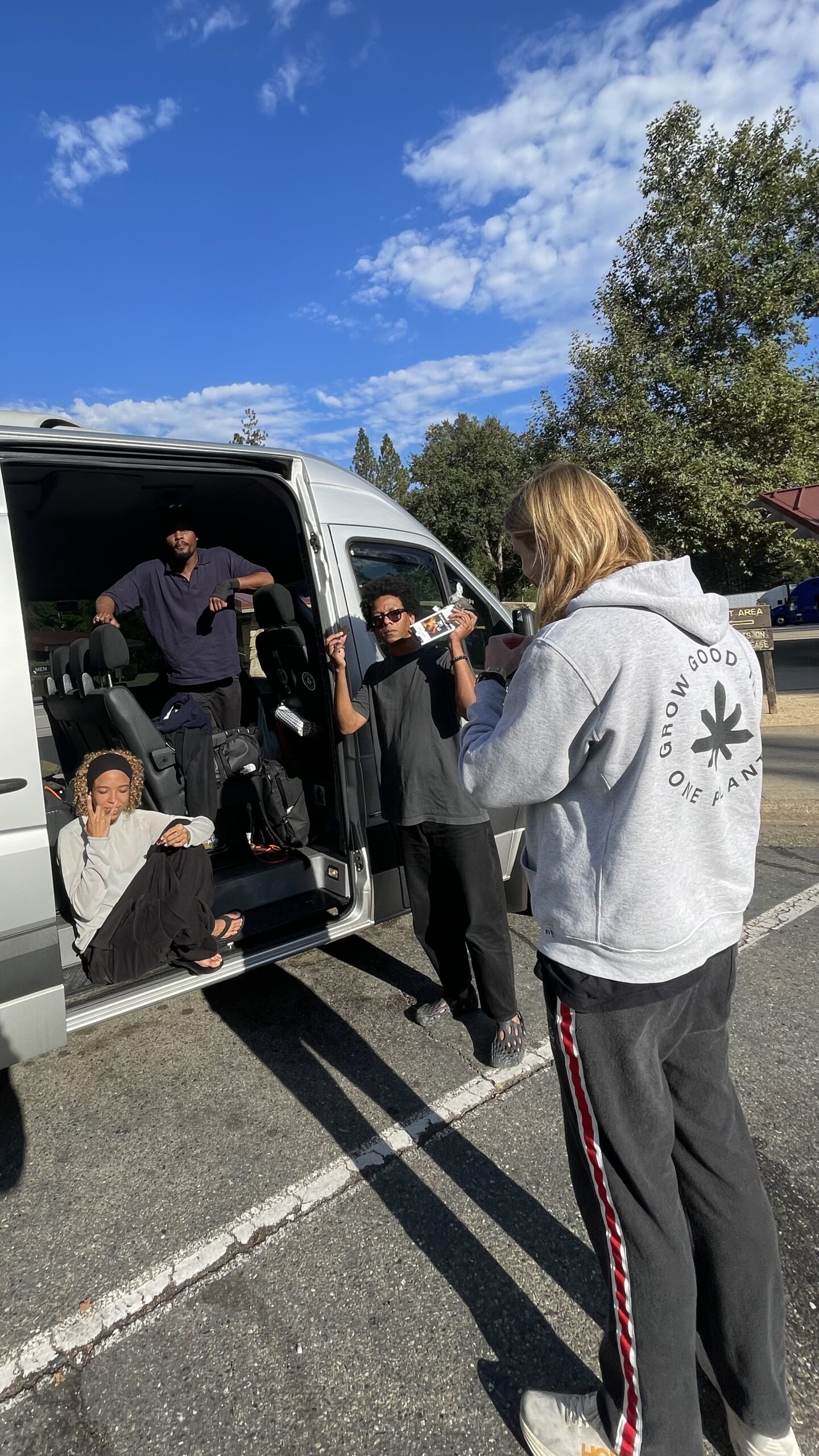
BROWN: I thought I would, but I think my brain is changing. I took little breaks during this tour. We would all kind of fall into little patterns and mine was, I’d wake up around eight or nine, and I would ask the tour manager for the keys to the van, and I would just get really stoned in there and be alone.

SANDSTROM: Nice.

BROWN: I’d maybe get some food, or just get really stoned in the van and scroll on my phone or make some music, maybe. Also, hot tea was a big thing. I always started the morning with something hot.

SANDSTROM: That’s wholesome. Who do people compare your voice to?

BROWN: I’m trying to think. I’ve gotten Nate Dogg.

SANDSTROM: [Laughs] That’s so funny.

BROWN: Yeah. Twitter is so funny. Sorry, X. 

SANDSTROM X! Are there more classic R&B artists that you get compared to?

BROWN: Not really, to be honest. Maybe P.M. Dawn. But not really ’cause I’m a singer, but I’m not really a singer, you know?

SANDSTROM: Yeah.

BROWN: A lot of my music is within the context of R&B music, but I’m kind of shifting it, maybe into the context of avant-garde or indie music.

SANDSTROM: It’s kind of experimental.

BROWN: Yeah, experimental. And at the same time, it’s kind of adding pop songwriting to it or pop structures. But a lot of my stuff comes from SWV and nineties R&B, and Whitney Houston. 

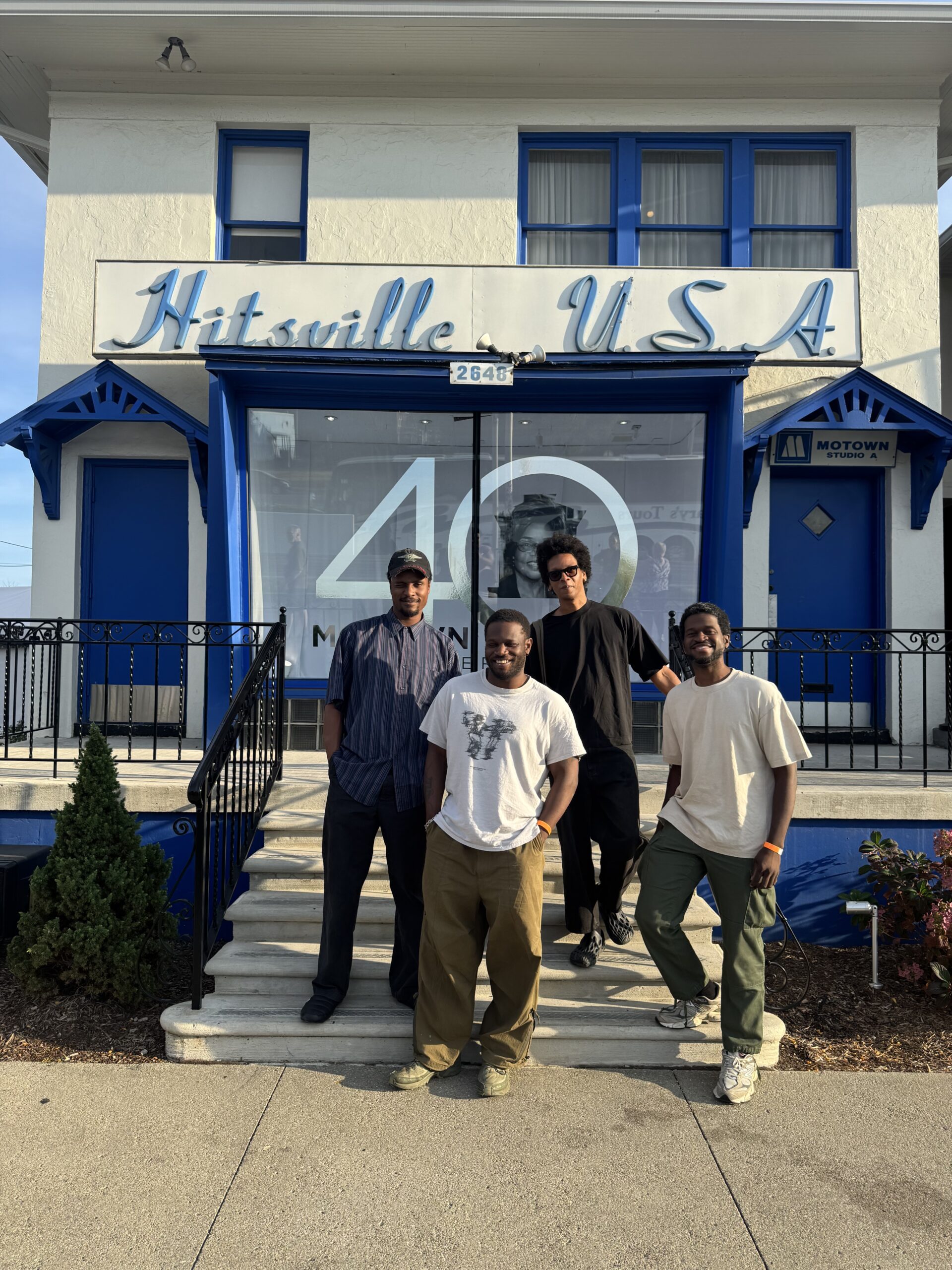
SANDSTROM: Wait, this is cool. Hitsville, USA.

BROWN: Yeah, but we weren’t able to get in. Once we got there, they were like, no more tours.

SANDSTROM: Fuck. That’s cool though. Was Motown really formative for you?

BROWN: Yeah, it was some of the first music I’d ever heard in my entire life.

SANDSTROM: Anything particular that jumps out?

BROWN: A lot of the Marvin Gaye stuff. Or honestly, a decent amount of Jackson 5 and also Diana Ross. When I got into Berkelee, I actually got obsessed with that seventies Motown, that really psychedelic era. But I’ve always had a really eclectic taste in music. I was listening to the Backstreet Boys, but I was also listening to D’Angelo and Michael Jackson and Eminem and Kanye. 

SANDSTROM: What are some artists that have come up around the same as you that you’re into?

BROWN: I was always really into Chanel beads. I’m really happy that YHWH Nailgun is getting more attention ’cause I’ve always thought they were really cool. 

SANDSTROM: Oh, nice.

BROWN: I’m a really big Florence Sinclair fan. I’m a big Anysia Kym fan. I mean, Mike [The Rapper] wasn’t coming up at the same time as me, but I’m a big fan of his. And Tony Bontana in the U.K. 

SANDSTROM: The other day I was thinking about how much rap music references Tony Montana.

BROWN: Yeah, Scarface is literally the fabric of hip hop.

SANDSTROM: It really is.

BROWN: It’s beautiful.

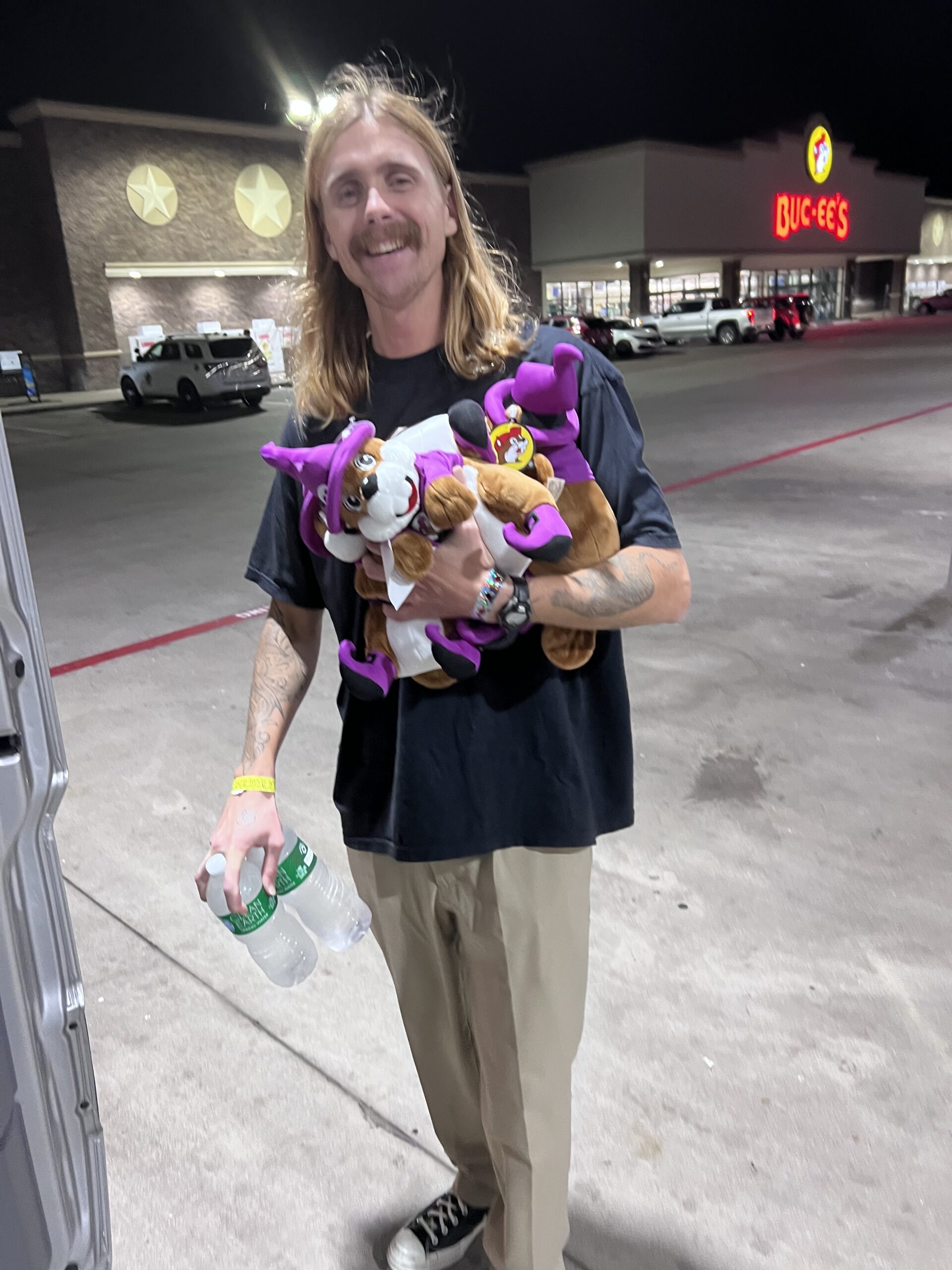
SANDSTROM: That’s Buc-ee’s?

BROWN: God. He’s obsessed with fucking Buc-ee’s. Him and Carrington are in the Buc-ee’s cult.

SANDSTROM: Did he win these or buy them?

BROWN: No, he used his own hard-earned cash to purchase those. He bought five of them. 

SANDSTROM: Makes you think.

BROWN: Really, really. I was thinking.

SANDSTROM: What is the Buc-ee’s cult? Just like people who are really into Buc-ee’s? 

BROWN: Yes. It’s a part of their fabric. It’s like their Scarface. The joy that would come over their faces when we would see the Buc-ee’s sign… They would be in a deep sleep, and then all of a sudden just wake up. 

SANDSTROM: That’s hilarious.

BROWN: It was horrible.

SANDSTROM: What are you most excited to do in Europe? 

BROWN: I’m excited to have a front-of-house engineer touring with us, and I’m excited to play cities that we haven’t played before. I haven’t really been to some of these cities in a long time. I haven’t been to Berlin in two years, which is crazy. I’m always excited to play Paris. And also, I think Poland is sick. Eastern Europe has always held me down. I’m excited to drive around Europe as well.

SANDSTROM: Cool.

Leave a Reply

Advertisement

image
MOST POPULAR

Filmmaker Grant Gee Shifts From Radiohead And Joy Division To Jazz

image

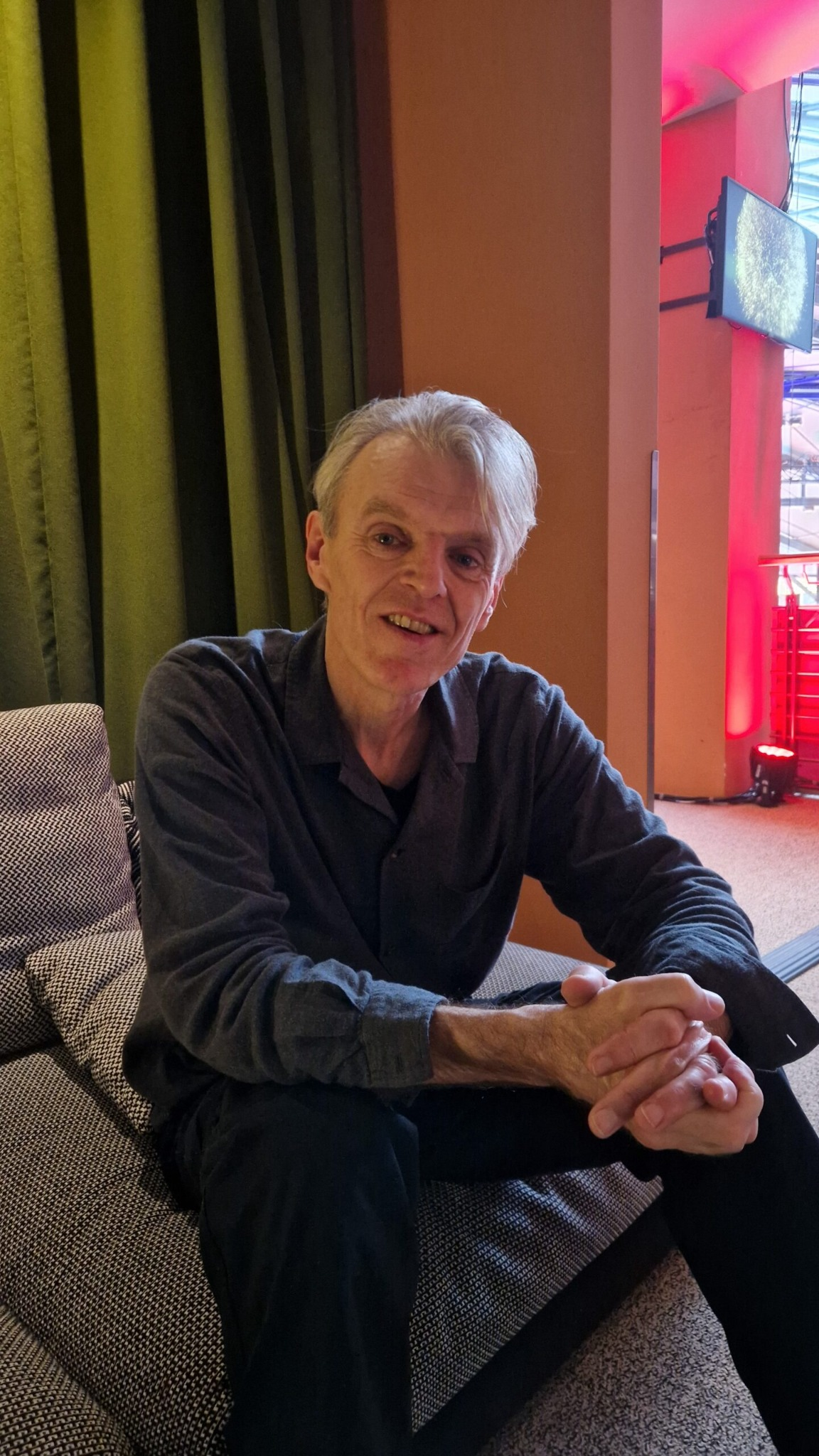
Over the course of his career, veteran documentary filmmaker Grant Gee has followed musicians (Radiohead, Joy Division, and more), novelists (Orhan Pamuk) and essayists (W.G. Sebald). And now, he is back with something completely new—a biopic titled Everybody Digs Bill Evans, which premiered last week at the Berlinale Film Festival. We meet the titular jazz pianist, played by Anders Danielsen Lie, during the worst moment of his life, right after the untimely death of his close friend and collaborator Scott LaFaro. The film, viewers realize, proceeds more like a thought experiment than a conventional biopic. Gee, 61, is more interested in the psychology of suffering, opening the film with a cross-cutting sequence that juxtaposes Evans’ and LaFaro’s concert with the latter’s death and its aftermath. The memory of music, emphasized by black and white colors, becomes a Proustian madeleine.

Our interview is scheduled two days after the now-infamous Berlinale press conference during which Wim Wenders argued that the cinema should “stay out of politics”—another reason why the festival has seemed to gradually decline in stature over the last couple of years. When I notice Gee from a distance in the 1,600-seat Berlinale Palast, he appears withdrawn, confirming my suspicion that Grant Gee the man might, like Grant Gee the filmmaker, prefer the shadows to the spotlight. Shortly after his film’s world premiere, he joined me to talk about his very first contact with Evans’ music and the real difference between making a documentary and a feature film.

———

JAN TRACZ: Thank you for finding time.

GRANT GEE: It’s a pleasure.

TRACZ: How is Berlin treating you so far?

GEE: I haven’t seen a great amount of it this time, but I’m back for another job for a month in a few weeks time.

TRACZ: Can you say what kind of job?

GEE: I have another strand of work, which is working with theater directors who use film and video in their stage shows, so I’m working on a show at The Schaubühne.

TRACZ: David Byrne was there two nights ago. Did you manage to talk?

GEE: No, no.

TRACZ: I ask because, first of all, I would love to see a documentary of yours about The Talking Heads. Before Bill Evans, you haven’t done a film on an American artist, right?

GEE: Is that right? Yeah, that’s true.

TRACZ: What happened? 

GEE: There was no conscious changing of mind. The conscious thought was I started directing music videos that led to a couple of music documentaries. And after the second one I thought, “Okay, if I do any more of this stuff, I’m going to be typecast as the guy that does music films forever.” I didn’t want that at that time. Before this, the last music film I did was 2007, nearly 20 years ago, and I’d been trying to get another one made. And it was really almost by accident that this odd little novel about an American jazz musician was the one.

TRACZ: Do you remember listening to Bill Evans for the first time?

GEE: Yes, I absolutely do. I saw a photograph of Bill, I didn’t know who he was, and there was something about his expression in this photograph which was fascinating and made me want to listen to whatever music this person made. So I asked a friend: “Where do I start with Bill Evans?” He said, “Well, get the Sunday at the Village Vanguard album.” I got it. And I can remember putting on the first track, “Gloria’s Step,” with no expectation of what was going to come out of the speakers.

TRACZ: What did you feel? 

GEE: I would have felt enchanted and charmed and excited by the deft delicacy of it. Something like that. I can’t put it into words, but I can remember the feeling.

TRACZ: What made Evans so special?

GEE: I don’t know enough about music to be able to say what made him different from other piano players. I only know it in terms of feel. I think there’s something maybe about he’s got a more rhapsodic quality than many pianists. There’s a chapter in a great jazz book called Meet Me at Jim and Andy’s, by Bill’s friend Gene Lees; it’s portraits of a number of great jazz musicians and titles the chapter on Bill “The Poet.” I don’t know how Bill’s technique is more or less poetic, but I think one can feel that there’s a poetic melancholy, even in the most sentimental of standards that he covers.

Grant Gee

TRACZ: Tell me more about Evans’ grief.

GEE: All I know is, in the film, he didn’t talk a great deal about it. He didn’t say much about it in interviews either. What do we know about Evans’s grief? It’s odd because so little was actually written about him by people who knew him or about his emotional life. What has survived has been Chinese whispers based on one interview. So for instance, his close friend Gene Lees, who wrote the book that I referred to earlier, wrote that “He never really got over Scott [LaFaro’s] death.” That’s one person’s opinion, but it’s probably the only person who actually knew Bill, so anybody who’s written about him since has taken that quote and refracted and refracted. But if it’s true that he never really got over Scott’s death, then you work backwards to be like, “Oh, shit, what must that have been like at the time?”

We do know that after working on Kind of Blue, he decided that the modal music that he was making with Miles [Davis] wasn’t the direction he wanted to take. He wanted to lead his own trio. He’d had a trio before he worked with other musicians before. But the Scott LaFaro and Paul Motian Trio was the one where it all came together. So Bill is achieving his professional and creative dream by 1960. It reaches its apogee at the Village Vanguard in 1961. And 10 days later, Scott’s dead. That trajectory… What is that? What happens after that? He never really got over that. Let’s just imagine how that might be.

TRACZ: When I was driving here today, I was listening to Undercurrent, the album that was out a year after.

GEE: Oh, yes. I love, love, love that one.

TRACZ: And I have to say, it hits different after watching the film. He was trying to find peace after death. But was he able to find his peace, do you think?

GEE: Who knows whether he found peace or not. Undercurrent is interesting because it’s a duet with Jim Hall and I think they all could relax more when he was not Bill Evans leading the Bill Evans trio. Did he find peace? The next album that he made as leader of a trio was at the end of 1962 or maybe end of 1962, I think. You’d struggle to hear any grief in that. But whether he found peace? Yeah, I honestly don’t know. Everything I know is in the film.

TRACZ: Do you remember the cover of the album, Undercurrent?

GEE: Yeah, yeah. Yeah.

TRACZ: Because I was thinking of that photograph, this Weeki Wachee Springs.

GEE: I’ve been to Weeki Wachee Springs.

TRACZ: Yeah?

GEE: If you look at a video for the band Supergrass called “Low Sea,” it’s shot in Weeki Wachee Springs, and I shot some stuff on that and they still have mermaid shapes there, or they did 10 years ago.

TRACZ: Wow. This is your first feature, right?

GEE: First drama feature.

TRACZ: Drama feature. And is there a real difference between documenting artists and directing actors?

GEE: It’s really hard to say. It’s all filmmaking. So, fundamentally, it’s the same thing. It’s just different components of the film. Obviously in a drama, the actors are a component that you have very little of in documentaries. The biggest difference for me is, with documentaries, you’re doing so much yourself. I was joking, but other people carry things around for you when you’re doing drama, you don’t have to carry all the stuff yourself. It’s like the difference between being in an orchestra and being a solo musician. Directing actors to the extent that you need to do for a drama feature was a new experience for me. I expected that my skills in the room actually doing detailed technical direction were not going to be the best, so I tried to compensate by what I thought my strengths were, which is giving them all contextual and psychological information beforehand and talking a lot about roles. And to my mind, I did relatively little active directing. We blocked everything out, but I was asking a lot of questions. And if they had any questions for me, I would answer as best as I could. But it was about allowing the actors to propose what was going to happen here.

Everybody did so much more for this film than I imagined that they would. There was a real sense of letting people do what they do. And to a certain extent, that’s part of my nature. When I teach documentary students I’m always saying, “Just do what you do and don’t tell people what they should do. Let them do what they feel they should do, and then just a little bit of shaping, maybe.” But with people of this caliber, you just let them do what they do, and if they’ve got any questions, they’ll let you know, and then you answer those questions as best you can.

TRACZ: Can I ask you a final question?

GEE: You can ask as many questions as you’d like.

TRACZ: Death appears on so many levels in this.

GEE: Death? Yes.

TRACZ: LaFaro dies, the ex-girlfriend and the brother kill themselves, and Evans was also very young. 51, I think.

GEE: Yes.

TRACZ: What’s your personal relationship with death?

GEE: I’m getting old, so one’s aware of it getting closer. It’s weird, isn’t it? The film about Joy Division, Ian Curtis killed himself. But I don’t know about my relationship with death. What’s the Woody Allen line? “Death’s all right. It’s dying that’s the problem.”

TRACZ: That’s a great conclusion.

Leave a Reply

Advertisement

image
MOST POPULAR