Hip-Hop Lives Here

Hip-Hop Lives Here
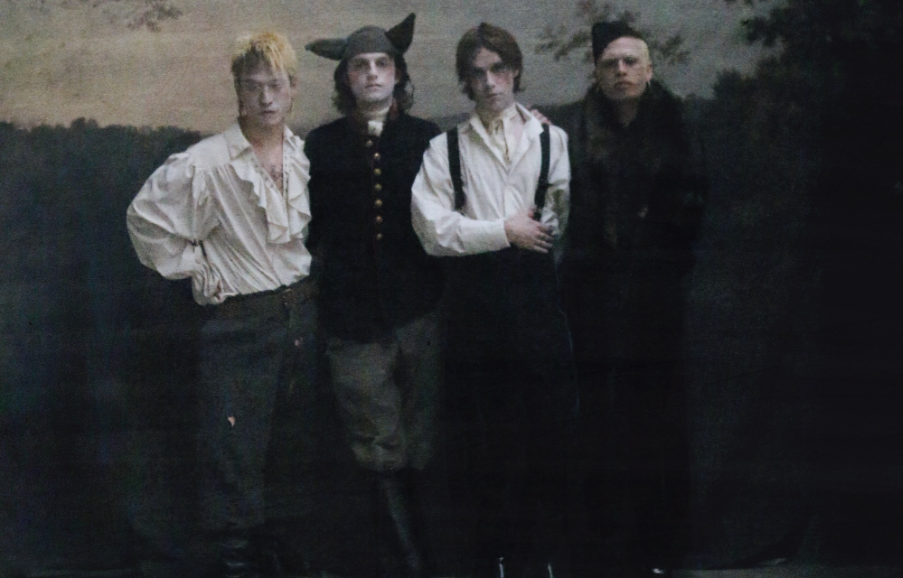
Stop scrolling. Look up. Let your imagination run free and make your own decisions. These are the genuine desires hidden beneath the chaotic exterior of ‘Fangs’, the bold third album from south London art-rock quartet HMLTD. Its stories of cocks and cuckolds, German philosophy and biblical sacrifice compete for attention against a sound that shifts between musical theatre, gabber techno and a style of industrial EDM the band have dubbed ‘ÜberGoth’.
The album explores these ideas through the figure of gothic horror’s most stylish villain, the soul-sucking vampire. Beneath the dark imagery, however, ‘Fangs’ examines the dangers of social media and the consequences of blindly following algorithms. “The vampire lives this existence bereft of love, bereft of sunlight, bereft of any joy except the addiction of consumption. And I think that modern man is subject to that same narrowing,” explains frontman Henry Spychalski.
For his conversation with NME, Spychalski has picked Maison Bertaux, a French patisserie dating back to the 19th century in the centre of Soho. As with much of HMLTD’s world, the choice of setting is intentional. Sporting slicked-back, bleached hair and a long, sharply tailored black coat, Spychalski settles down for a cream tea while explaining his ambition to embrace the life of a “flâneur”, a Baudelairean bohemian, by spending as much time as possible in places like this. Thoughtful and expressive, he is someone who rarely chooses one syllable when four will do. However, in the lead-up to ‘Fangs’, the singer and his band began to drift away from the unconventional way of life they had held onto since forming a decade earlier.
An entire album, titled ‘Where Is The Tunnel, This Must Be The Light’, now sits abandoned in HMLTD’s archives. The band spent a year making it, using £40,000, which accounted for most of the advance for their third album. “We recorded it very much as a traditional band in a studio, and I think that what we ended up with was something that we felt very disconnected from. I don’t think it had anything to do with what HMLTD is really about, which has always been experimentation and trying to push the boundaries, even if you fail,” Spychalski says.
“We ended up sounding like Neutral Milk Hotel, and I like Neutral Milk Hotel, but I don’t want to be Neutral Milk Hotel because I want to be something new – or at least try to be. I’d rather try and fail to do something new than succeed at doing something that’s already been done.”
‘Fangs’’ sneery, glammy lead single ‘I Used To Ride In Limousines’ acts as a manifesto of sorts. In musical theatre, Spychalski explains, “you have this notion of the ‘I want’ track, where the main character projects their future success and their future glories.” Having signed in their infancy to Sony Music, before soon parting ways and eventually releasing 2020 debut ‘West of Eden’ and its conceptual 2023 follow-up ‘The Worm’ through independent label Lucky Number, HMLTD’s version of the “I want” track became its inverse.
“It’s about the ego death that you go through when you have that form of success, and then you lose it in some sense,” the vocalist says. “It’s about wanting to be free of those notions and to have your own totally self-defined version of success that isn’t contingent on any kind of external voice – one that refutes the notion of success full stop, and that actually delights in the liberty of failure.
“As soon as you start trying to manipulate your work in order to appeal to an external audience in any form, you slowly start to become more and more alienated from it. Whether that’s in the context of being on a major label or trying to get X amount of Instagram followers, I don’t think it makes too much of a difference,” he continues. “The point is that you’re prostituting yourself and you’re going to start making work that doesn’t truly reflect you. And with that process, there’s no black-and-white line where a devil comes into the room, and you sign your soul away. It’s far more insidious, and it happens in increments.”
“I’d rather try and fail to do something new than succeed at doing something that’s already been done” – Henry Spychalski
As pushback, the ethos behind creating ‘Fangs’ became one of “trying to shield yourself from outside influence as much as possible”. During the bulk of its creation, Spychalski downgraded to a “dumb phone”. To make the album, the band – completed by guitarists Duc Peterman and Theo Spark, and drummer Andrei Martynchyk – decamped to the French countryside for a month, to a “crumbling, decadent, gothic old house surrounded by vineyards” where the only thing to do was create. At the start of that period, Spychalski lost his voice, “so I just read vociferously and really immersed myself in a few books which largely informed the world of the album – Revolutionary Demonology by this Italian occult philosophy collective called Gruppo di Nun, and a lot of Julian Evola, who’s a kind of early 20th-century spiritual fascist.”
Proudly intellectual (“I think that one of the reasons why guitar music is dying as a genre is because it assumes far too little of its audience,” suggests Spychalski) yet riddled with pithy one-liners, winks and the sort of pounding beats made for dark rooms and strobe lights, HMLTD’s work demands that it’s possible to be both serious and fun. “If I’m writing a song about vampires on New Year’s Eve or ketamine or cuckoldry, I’m trying to think, ‘OK, how can I work a reference to Wagner into this? How can I use this to talk about Hegel?’ I love high culture, and I love low culture. The only thing that I really abhor – which I think is the dominant cultural mode of our time – is mid-brow culture,” the frontman argues.
It’s this homogeneous levelling out of ideas that HMLTD are most repulsed by. “I’m not saying anything original here, but Instagram is destroying culture and destroying art more than we realise,” Spychalski states. Instead, ‘Fangs’’ Venn diagram of inspirations feels genuinely unique to its authors. ‘Chateau Vamp Freestyle’ is like a Slavic Sweeney Todd: an uproarious knees-up born for the stage.

“People sometimes accuse us of trying to be cool, but if you listen to ‘Chateau Vamp Freestyle’ then there’s no way that you can possibly level that accusation at us. I think what makes us good as a band is actually that willingness to put our neck on the line and be ready to receive ridicule,” Spychalski suggests. Meanwhile, ‘Close To You’ might be the only song in history that sounds like Crystal Castles but references The Carpenters. “Why do bats suddenly appear / Every time you are near?” goes one particularly amusing line.
There are happy hardcore songs about obsessive lust (‘Blitzkrieg’) and multiple lyrics that reflect how “masculinity is in a deep moment of crisis”. In just one verse of juddering opening track ‘What The Hell’, the frontman manages to reference Ugandan warlord Joseph Kony, tennis star Maria Sharapova and the musical alter-egos of his bandmates, Skinship (Spark) and Saigon Fury (Peterman). HMLTD’s third is a record that will have you looking up reference points and going down information wormholes at every turn. It’s willfully, wildly curious, and it hopes the same for its listener.
“I am really proud to be a try-hard. I think that we all have to try really, really hard just to stay sane at the moment because the internet, and social media in particular, is destroying the western world from the inside out. It’s a cancer,” Spychalski says. “So I want my music to hopefully [open the door] to other ideas in the same way that a lot of the artists that I listened to growing up did for me. I discovered Albert Camus through The Cure song ‘Killing An Arab’; I discovered English new wave cinema through Morrissey. When artists introduce you to these other ideas, whatever they are, it becomes a gateway to a whole world beyond the music itself.” Step into the world of HMLTD and ‘Fangs’, and you’re in for one hell of a ride.
HMLTD’s ‘Fangs’ is out now via Lucky Number.
 Share
Advertisement

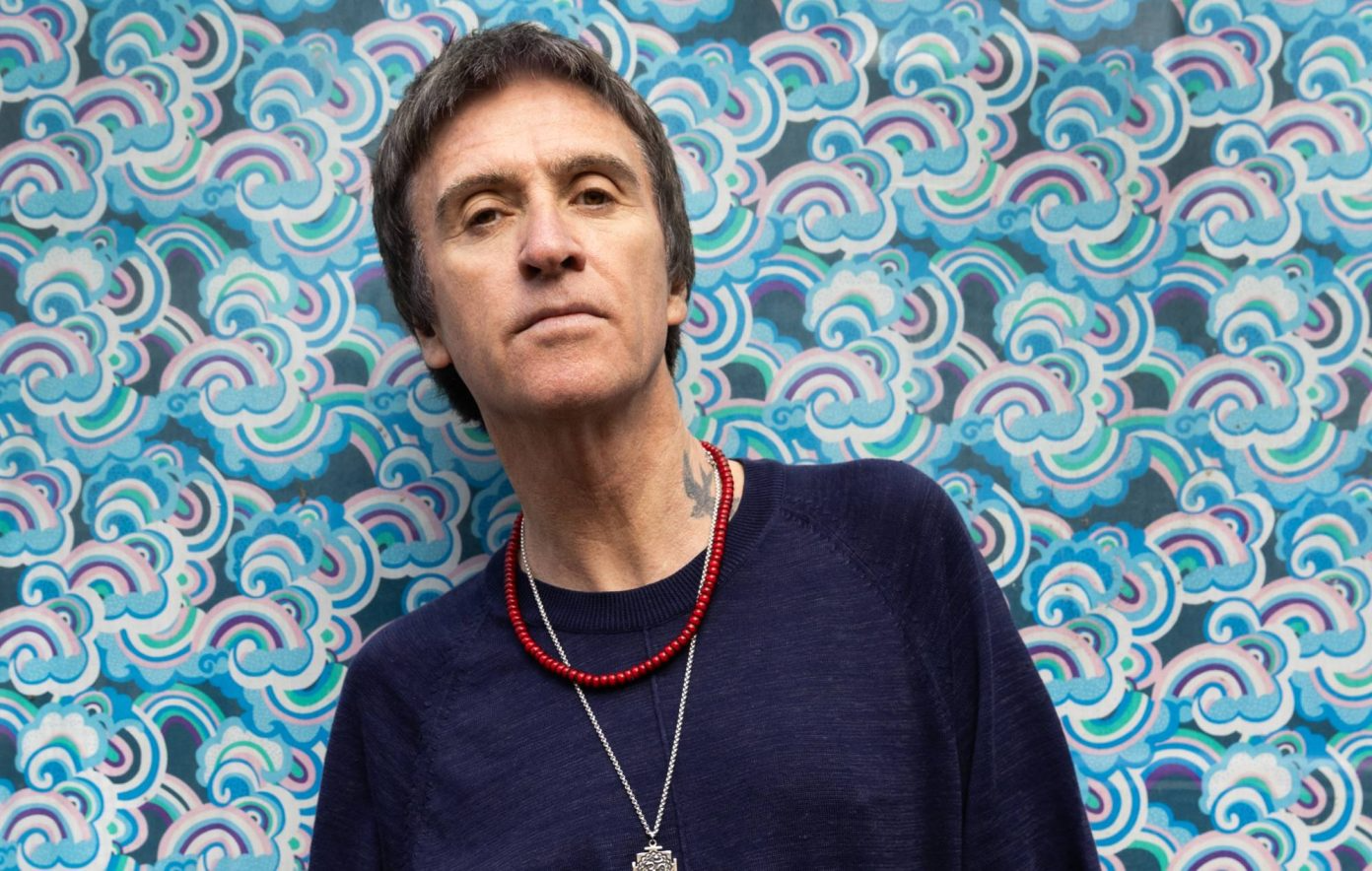
Would Johnny Marr place one of his solo songs ahead of favourites from The Smiths and Electronic? His choices are revealed in NME’s Blind Ranking video below.
Ahead of the release of ‘The Age Of Everything’, which arrived last Friday, October 2, NME sat down with the guitarist for a look back through his catalogue. Marr was challenged to place five songs in order of greatness, choosing a position for each without knowing which song would follow.
Electronic’s ‘Getting Away With It’ came first, with Marr saying it “goes down very very well, even if people are hearing it for the first time”. Next came ‘Spin’, taken from his latest solo album. Reflecting on the newer song, he admitted that “not everybody knows it, but it makes an impression”.
When ‘This Charming Man’ by The Smiths came up, Marr observed: “Obviously it’s very well known, but it goes by so quick.” The track remains a “connection” to his younger self, he explained: “I can hear the young man who wrote those guitar parts”. He described his 2014 solo release ‘Easy Money’ as “pretty catchy”, adding that it “goes off bigger than any other at any gig”. He then considered another much loved Smiths song, ‘There Is A Light That Never Goes Out’.
“Beautiful song to play. Very proud of it still,” Marr reflected. Recalling a recent performance in Liverpool, he added that “it occurred to me that it’s the ‘You’ll Never Walk Alone’ of my generation.”
See where each song landed in Marr’s ranking by watching the video below, then share your own order in the Instagram comments.
The wider conversation with NME covered his “emphatic” album ‘The Age Of Everything’, his admiration for The Cure and Fontaines D.C., and his thoughts on why Andy Burnham should be able to listen to The Smiths. Read the complete interview with Marr here.
A Liverpool concert on November 14 is next on Marr’s schedule, followed by a brief run of dates with stops in Mexico, São Paulo and Chile. His largest solo headline performance to date at OVO Arena Wembley had been planned for later this month, but has been postponed, with a replacement date yet to be announced.
Share
Advertisement