Hip-Hop Lives Here

Hip-Hop Lives Here
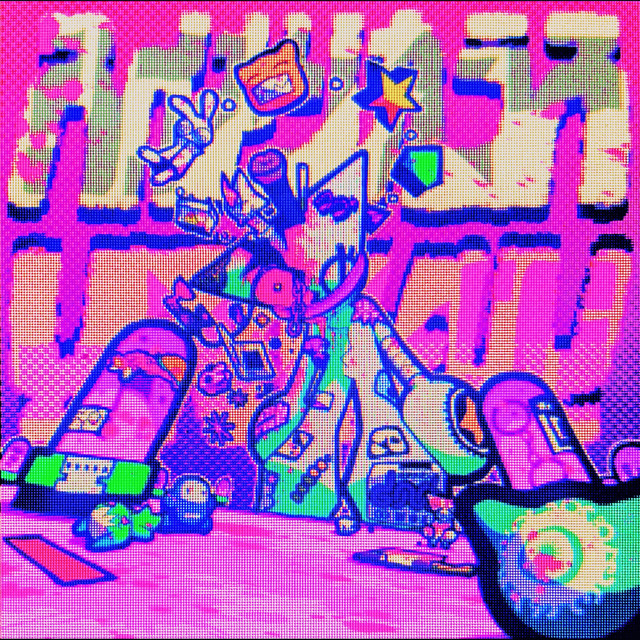
To hit play on femtanyl’s “KATAMARI” is to be sucked into a wormhole of mad breaks and robotic cries that suggest a malfunctioning Five Nights at Freddy’s animatronic. “Bruises on my neck/Just a doll of flesh/You'll find my smoking body hung in wires overhead,” the voice whines, glitching like a computer with malware in a 1996 sci-fi movie. This is a feral simulacra of old-skool rave music, made by a producer born after the scene’s golden age ended and who likely grew up tapped into already diluted tributes to hardcore electronica, like Machine Girl. Literally feral: Though not a furry herself, femtanyl’s fanbase is full of them; she’s collaborated with furry artists like MAILPUP, and her covers feature a gleefully disfigured cat-like creature—knives in the forehead and cheek; pancake flat from a spike ball—named Token.
The on-the-bloodied-nose mayhem of the music—rife with cannibalism references and overclocked synths—has made the 21-year-old equally beloved and reviled. Haters say it’s grating noise, but that’s just made her fans even more steadfast, giving “femtanyl truther” the status of a marginalized identity. “These days it may be easier to come out as gay than to come out as a femtanyl fan,” as one popular meme jokes. But it’s not that serious. Rising above the vitriol alongside a growing wave of breaks-heavy rave producers like Vertigoaway and DJ Kuroneko, femtanyl may finally be the one to bring digital hardcore to the masses.
REACTOR is femtanyl’s second EP, the follow-up to last year’s CHASER, a relentless hamster wheel of energy. Nearly every beat revolves around chattering percussion, peaky synths, and stabs straight out of 1992. The concept of “negative space” has been annihilated; garbled cries of people who sound off their nuts inundate the mix alongside atmospheric samples like baleful monologues from The Exorcist III. Almost every song feels like it could soundtrack a Ridge Racer level; the treble sounds made for aliens who can only hear at high frequencies.
In the tape’s least dynamic and most forgettable moments, the formulaic hardcore rave clutter has the same placeless, amorphous essence that Nintendo gives its Mario bossa nova tunes. But REACTOR mostly intoxicates, thanks to the bright, infectious synth loops with hooks as sharp as pop jingles. They irradiate and clash with the dark witches’ coven of unsettling vocal styles lurking beneath, from metal howls to echoing warbles. The jittery sandstorm of “WEIGHTLESS” practically drowns femtanyl’s screams. It took me numerous replays to realize this music wasn’t a happy-go-lucky joyride. It’s more like hardgore breaks.
This is a dank realm where “spiders shoot out of guts,” puke spills across the backs of cars, shotguns paint the shower, and thumbs press nerves deep inside the narrator’s eyes. It’s Atari Teenage Riot for zoomers hooked on creepypastas, fan-fic, and the FPS game Ultrakill. femtanyl has spoken out about drug and mental health issues she’s been through, and it’s easy to read the ferocity as a cathartic outpouring. There’s also a joyous defiance to tunes like “IT’S TIME,” which comes alive when the punk maelstrom of drums and shrieks slows down and a bizarrely angelic hum drifts in. Danny Brown offers a sweet reprieve from the havoc on “M3 N MINE,” bobbing between the beat like he’s moshing on a unicycle.
REACTOR’s sleeper highlight is “ATTACKING VERTICAL,” which originally wasn’t supposed to be a song—femtanyl posted it on Twitter as a scrapped demo, but then came back and dropped it. On a tape of nonstop tumult, it’s surprisingly soothing, a dreamy deep-water drift. The vocals are so low and choppy—imitating the robo-drone of a text-to-speech machine—they’re like mutant percussion. It feels almost like a failed time-travel exercise, or an unsuccessful track from the ’90s rave era—someone from the outside trying to make an anthem but not quite pulling it off, which is exactly femtanyl’s position. The imperfection is part of the allure, like a raw file you’d find on a disc at a DIY hacker convention. It’s charming anemoia factor feels perfectly in line with femtanyl’s greater project, making you yearn to experience a time you never lived in.
 Share
Share
Advertisement


Isaiah Rashad does not hide behind metaphors on his latest album, It’s Been Awful. The title alone tells listeners exactly where his head has been. Honesty has always been central to Rashad’s music, from his breakthrough 2016 project The Sun’s Tirade to 2021’s The House Is Burning. Across his career, the Top Dawg Entertainment artist has carved out his own lane with hazy Southern rap, neo soul textures, and deeply personal songwriting that often goes far deeper emotionally than many of his peers.
Rashad’s previous album arrived after a difficult period involving homelessness and rehab, and this new record comes following another painful chapter in his life. Between relapses, fractured family relationships, and the invasion of privacy that followed the leak of a sex tape in 2022, It’s Been Awful feels like the sound of someone confronting everything at once. He wastes no time addressing it on opening track ‘The New Sublime’, where he raps, “Feel afflicted, falling over / Ask me who I’m fucking, I been fucking up.” The song dives into his fears around sobriety, his sister’s incarceration, and the emotional impact these struggles have on the people closest to him.
Themes of addiction and self destruction continue to run through the album. On ‘Same Sh!t’, a track carrying influences from A$AP Rocky and Skepta, Rashad references substance abuse directly with the line, “The pills, the blow, the ‘yac, the top,” while nodding to classic Lil Jon energy. ‘M.O.M’ captures the cycle of temptation and compromise as he tries to resist one vice only to replace it with another. Elsewhere, he speaks openly about the physical damage these habits have caused, admitting, “The doctor say that shit been fucking with my heart / but I can’t barely sleep / chasing money, love and all of the amphetamines.”
The emotional weight deepens on ‘Act Normal’, where Rashad examines generational trauma and learned behaviors passed through family lines, reflecting on “Acquired secrets / Learned to be the best at it.” Then on ‘Do I Look High?’, he strips away any remaining distance between himself and the listener with one of the album’s most vulnerable admissions: “Last time that I told you that I was clean, I was lying / I’m praying that my sister makes it home by Christmas morning.” The album’s brutally detailed storytelling may feel heavy for some listeners, but that raw specificity is exactly what gives the project its emotional power.
Still, It’s Been Awful is not consumed entirely by darkness. Rashad has spoken about music as something healing and transformative, and throughout the album he refuses to let despair completely swallow him. Inspired by artists like Prince and OutKast, the project carries a warm, sun faded atmosphere that softens the pain without hiding it. ‘Supaficial’ glides forward with bright trumpet accents while Rashad casually delivers lines like, “Where you going? You a junkie, you been way outside.” Meanwhile, ‘Happy Hour’ turns emotional exhaustion into something strangely melodic, pairing confessional lyrics with dreamy piano production. At its best, the album feels like Southern rap drifting through late night R&B haze during a summer drive with the windows down.
On ‘Superpwrs’, Rashad sums up the cycle he seems trapped inside, asking, “How I get sober, fucked up, then clean again, I don’t know,” before acknowledging his own disappearing acts from music with, “How you be rapping circles around n****s, but you don’t drop, I don’t know.” His skill has never been the issue. The real obstacle has always been life itself. But with It’s Been Awful, Isaiah Rashad delivers one of his most honest and affecting projects yet, making it impossible to overlook him any longer.

Share
Advertisement